
Saturday, March 5, 2011
Marketing support from the Seattle University Marketing Club


Monday, February 28, 2011
The new governor of Oaxaca announces a joint agreement with the IADB
Gabino Cué, the new governor of Oaxaca state in Mexico
Monday, February 21, 2011
Biohabitats acquires Natural Systems International
Wednesday, February 9, 2011
Water for Humans and SU Law - Initial Meeting
Today, Water for Humans (WFH) met with Misha Sandusky and Joe Helt, third year law students at Seattle University, to start the process that will culminate in filing IRS Form 1023, our application for 501(c)3 status. We plan to submit the application in April at the end of their term. This is a class project for a nonprofit course they are taking and the price is right for WFH: pro bono.
Today, WFH gave Joe and Misha a verbal overview of our organization and how we arrived at this point of applying for our own 501(c)3 status, which will take us from under the umbrella of A W.I.S.H. (A World Institute for a Sustainable Humanity) for our tax exempt status. They had already done quite a bit of research from our website and the forms submitted to WAACO (Washington Attorneys Assisting Community Organizations), but we were able to clarify some points with this face-to-face meeting.
Misha and Joe outlined the information that need to be gathered or created to complete the application. Fortunately, we have some of the more time consuming parts done, like the Articles of Incorporation and Bylaws. The two major items that need to be done are a narrative of our activities (current and future) and our budget.
You can keep track of our 501(c)3 progress through this Blog.
Monday, January 31, 2011
Seattle University School of Law
Water for Humans will work with two third year law students at Seattle University to help us obtain our 501(c)3 status. This will be a project for the students’ Nonprofit Legal Clinic course. Judy Andrews, a practicing attorney and the professor of the course, will make sure that everything is done properly and after the course ends will represent us if the IRS has any issues with the application. The students will be given the assignment on Thursday, 2/3/11, and will set up an interview with Water for Humans shortly thereafter. The course ends in April. You will be able to follow the progress in this blog.
Wednesday, November 17, 2010
Mexican Farms Need a Water Revolution - IPS ipsnews.net
Mexican Farms Need a Water Revolution
By Emilio Godoy*
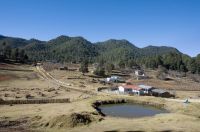
MEXICO CITY, Nov 17, 2010 (Tierramérica) - Without financing, many Mexican farmers cannot improve their ageing irrigation systems, which are essential if Mexico is to withstand the effects of climate change and reduce its emissions of greenhouse-effect gases.
Pressurised and drip irrigation are two leading-edge options that also make relatively efficient use of water and electricity, reducing power fossil fuel burning and greenhouse gases emissions.
These new systems are expensive, but "they would allow us to grow crops year-round and have more jobs and better incomes," farmer Oseas Espino told Tierramérica. He grows sorghum on about 30 hectares in the Yecapixtla municipality in the southwestern state of Morelos.
Espino is one example of the thousands of small and medium farmers who are unable to modernise their irrigation systems.
The most widely-used system is based on gravity, with electrical pumping equipment. But it "generates inefficiency in the use of water and electricity," Nemecio Castillo, an advisor with the National Institute of Forestry and Agricultural Research, told Tierramérica.
Seventy-seven percent of Mexico's piped water goes to agricultural use. There are some 118,000 wells for farming, but the authorities have rehabilitated just 6,000 of them.
Annually, operation of an inefficient well consumes about 200,000 cubic metres of water and generates 350 tonnes of carbon dioxide (CO2), one of the main greenhouse gases.
A well operated using modern technologies requires half the water and reduces greenhouse emissions to 98 tonnes of CO2, according to calculations by the non-governmental organisations El Barzón and Oxfam Mexico, which are promoting a plan to update the country's farm irrigation systems.
According to these organisations, inefficient water use in agriculture means that more than 80 percent of Mexico's 180 largest aquifers are overexploited and it is already difficult to sustain the total irrigated area.
The total farmed area in Mexico is more than 20 million hectares, with irrigation for 5.3 to 5.5 million hectares, according to the National Institute of Statistics and Geography. The most abundant crops are maize, beans and sorghum, which require a great deal of water to grow.
Maize -- used to make the tortilla, a staple in the Mexican diet -- requires 1,700 cubic metres of water per tonne produced, according to the Ministry of Agriculture. One tonne of sorghum needs 1,200 cubic metres of water per tonne.
Of the 630,000 registered farms in Mexico, just 16 percent have irrigation and 12 percent utilise unconventional techniques, report El Barzón and Oxfam.
There are 85 irrigation districts that cover 3.5 million hectares in hands of 583,000 users, particularly in central and northern Mexico, states the National Water Commission.
Those districts demand 30 billion cubic metres of water per year, 90 percent of which comes from reservoirs and 10 percent from underground sources.
From 2000 to 2009, agricultural electrical consumption jumped 17 percent. Government subsidies for energy purchases for farming -- about 50 cents on the dollar per kilowatt -- have cost 640 million dollars in public funds this year.
A traditional gravity-based system "irrigates one hectare in 24 hours, while a drip system does it in three or four hours," irrigation engineer José de Santos told Tierramérica.
According to Oxfam and El Barzón, the combination of an efficient well and modernised irrigation would be the equivalent of reducing CO2 emissions by 36 percent, energy consumption 40 percent and water use 50 percent.
Mexico emits 715.3 million tonnes of CO2 per year, six percent originating from agriculture.
Drip irrigation, which directs the water to the plant roots through soaker hoses, and pressurised irrigation, which uses closed pipes and sprinklers to create a directed precipitation, are the main alternatives to irrigation channels.
But their costs are quite prohibitive for small and medium farmers: 2,250 to 2,500 dollars to set up a system, according to figures from the United Nations Food and Agriculture Organisation (FAO).
An additional obstacle is the government's slow action on the problem. The Ministry of Agriculture launched the Strategic Project for Irrigation Modernisation, with a budget of 52 million dollars for this year and the goal to update 22,000 hectares, benefitting 1,500 farmers. But the farmers have to put up another four million dollars to obtain the equipment.
"The cost is very high. The problem is that many farmers rent their land, and the owners aren't interested in adding the technology," said irrigation expert De Santos.
Since 2006, the National Water Commission has modernised irrigation on 599,000 hectares, with financing of 240 million dollars. The goal for 2012 is to reach 1.2 million hectares with irrigation.
In addition, "we have to move towards crops that require less water," like garbanzo beans, vegetables, fruits and oil crops. "The farmers need to be aware that water is a finite resource," said farming advisor Castillo.
In any case, there is no alternative to modernisation: one hectare yields 27.3 tonnes if it is irrigated, compared to just 7.8 tonnes without irrigation. And climate change will only intensify the droughts that are already taking a toll on Mexican farming, warns the National Institute of Ecology.
* This IPS story is part of a series supported by the Climate and Development Knowledge Network http://www.cdkn.org (END)