
Water for Humans Gazette - July 2018
La Mazateca GEN2.1 (cookstove) Update:
Patent Filed in Mexico
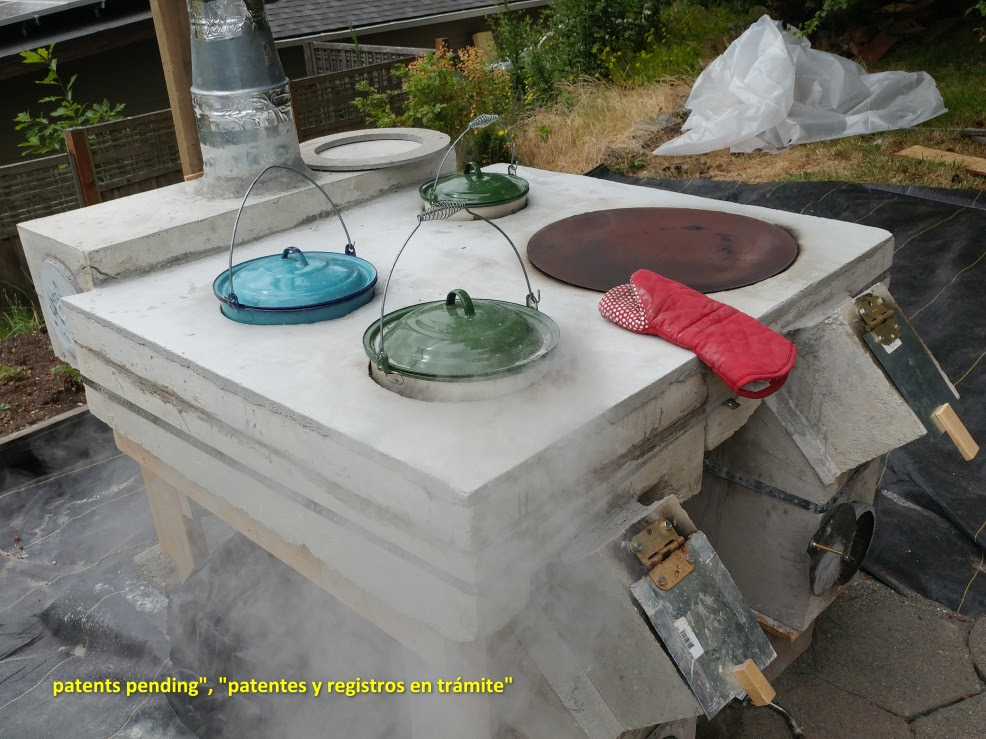
Patent application filed on 20 June! This has been a long time in coming. What we thought would be a 9-month process has turned into a 2.5-year long adventure. We can now publically show and talk about the new "La Mazateca Gen2.1" design.

In 2014 we received an award from the Licensing Executive Society International in Geneva, Switzerland, for our work on innovating, culturally appropriate technology solutions. From that award the law firm of Becerril, Coca & Becerril, S.C. (https://www.bcb.com.mx/) in Mexico City has been providing us with pro-bono intellectual property representation. On June 20 they filed our patent application in Mexico. We want to thank Hector Elias Chagoya Cortes and Mariana González for their hard work in guiding us through and completing the process. We also must again thank Fred Nopwaskey for his continued support and his work to produce all the required drawings and figures of the design.
Because of NAFTA and the fact that we are a nonprofit, the patent filing fees were reduced by over 50%. The patent is for the molds and the construction process of making "La Mazateca Gen2.1". This patent protection will allow us to obtain 'no bid' contracts from the Mexican government to take La Mazateca to other parts of Mexico. In addition, the protections will enable us to license the technology with other NGO's and companies to provide potential revenue streams. The one challenge we now face is that this starts "the clock ticking". We now have six months to file for protections in other countries.
Because of NAFTA and the fact that we are a nonprofit, the patent filing fees were reduced by over 50%. The patent is for the molds and the construction process of making "La Mazateca Gen2.1". This patent protection will allow us to obtain 'no bid' contracts from the Mexican government to take La Mazateca to other parts of Mexico. In addition, the protections will enable us to license the technology with other NGO's and companies to provide potential revenue streams. The one challenge we now face is that this starts "the clock ticking". We now have six months to file for protections in other countries.
Molds Ready to Ship to Mexico
La Mazateca Gen2.1 is ready. The heart of the innovation is that the Gen2.1 is molded using vacuumed formed ABS (thermoplastic) molding tools. Fred Nopwaskey and Steve Gary have taken our basic idea and turned it into the "real thing". Because of the need to test and verify the design, the ABS molds are made at Sound Manufacturing in Kent, WA. Now that the design has been verified and the initial eight mold sets are complete, they are finally ready to ship to Mexico.

We spent several days packing up the eights sets of ABS molds for shipping to Mexico. Our challenge was to safely pack the molds in the most efficient manner to minimize the volume. It took us a couple of days but we were able to pack everything onto two pallets (one tall and one short). This was a HUGE improvement from our estimate of three or four pallets.


Shipping Logistics
A longtime volunteer, Michael Sumner (lives in both Mexico City and US), has been leading the shipping logistics effort. Like many tasks, this has turned into a much more complex one. When we first started to work on this, we got bids for the shipping from $7K to $1,200, plus the customs and border fees. We ran head long into what seemed like an insurmountable wall. In order to get the shipment across the border, we need a "Registered Importer" to receive the goods on the Mexican side. This has turned into a quagmire. The first option, proposed by several of the logistics companies, was to hire a "comercializadora". This is a company that will "act as a Registered Importer" for a fee. The potential fees for this service are as much as the shipping! Thus, we needed a better solution. We then turned to our network in Mexico to try to find a solution. We leveraged our Mexico City Rotary contacts and with the help of Fausto de Anda E. we solved several parts of the puzzle (shipping logistics and temporary warehouse), but the Registered Importer still eluded us. Finally, Michael has found a Registered Importer that will receive our shipment. We are now receiving and reviewing the final bids for the shipping and logistics. Our hope is to have the molds on "the truck" next week and arrive in Mexico City 6 - 10 days later.
Securing Suppliers
With the help of Ulisis, Jose (a colleague of his) and Michael, we are rounding up all the supplies we need and the logistics of shipping them to the three regions for the upcoming workshops. Ulisis is a longtime colleague who is ex-staff of The Hunger Project, and he was with us for the first Gen1 workshop training several years ago. Ulisis has secured a company to cut and build the plywood molding tools. And with the help of Jose they have been able to secure suppliers for all the other required materials.
La Mazateca Gen2.1 Workshops in Mexico Delayed
Due to the unprecedented violence in Mexico prior to the elections (national, state and local) held on July 1st, The Hunger Project - Mexico(the NGO setting up the workshops) recommended that we postpone the workshops that we were planning to start in early July. The workshops now will be in September and early October. We have been using this delay to our advantage to lower the costs and improve the construction process. We are also enhancing the construction manual. One of the most costly parts of the stove is the "castable refractory" (ceramic like cement mixture). With the delay, we have developed a "homemade" castable refractory that costs 50+% less than our planned commercially made products. We have found a much lower cost alternative to the expanded perlite and by changing the molding process, the parts do not require extra finishing steps. In addition, with the help of Fred (CAD) we have further reduced the cost of the supporting structure and simplified the final assembly process.
There will be three workshops starting in September. The largest one will be in Chiapas where stove builders from Chiapas, Oaxaca and San Luis Potosí will be introduced to the Gen2.1 stove building process and will then proceed to build 8 stoves in Chiapas. The stoves builders from Oaxaca and San Luis Potosí will then return to their home states and begin constructing stoves there. In total they will build 25 stoves in Chaipas, 15 in Oaxaca and 10 in San Luis Potosí over the following weeks. Rick and Stan will travel to each of those states to clear up any remaining questions and to bring the remaining stove builders in each state up to speed.
There will be three workshops starting in September. The largest one will be in Chiapas where stove builders from Chiapas, Oaxaca and San Luis Potosí will be introduced to the Gen2.1 stove building process and will then proceed to build 8 stoves in Chiapas. The stoves builders from Oaxaca and San Luis Potosí will then return to their home states and begin constructing stoves there. In total they will build 25 stoves in Chaipas, 15 in Oaxaca and 10 in San Luis Potosí over the following weeks. Rick and Stan will travel to each of those states to clear up any remaining questions and to bring the remaining stove builders in each state up to speed.
New Website Launched
In January we launched our new website, using a WordPress platform. A huge THANK YOU to Ralph Beckett, and all our volunteers, who made this happen. Ralph did a lot of the heavy lifting and we appreciate the many hours of work he dedicated to this effort. The new website is more secure and easier to keep up to date. And, it will be easier for us to find experienced WordPress volunteers in the future to help us manage our web presence.
New Volunteers
SalesForce
We have several new volunteers: Andrew Chase, David Alevy, Neil Penso, Palak Shah, to manage and update our Salesforce CRM database. They are fast learners and have experience with the nonprofit version which is extremely helpful since it is very different from the "selling version". They are hard at work making the database more useful and bug-free.
Board Happenings:We have several new volunteers: Andrew Chase, David Alevy, Neil Penso, Palak Shah, to manage and update our Salesforce CRM database. They are fast learners and have experience with the nonprofit version which is extremely helpful since it is very different from the "selling version". They are hard at work making the database more useful and bug-free.
Charlie (Board Chairman) has a La Mazateca Gen2.1 cookstove in his backyard. He and Sarah will be hosting fundraising events in their home and showing off La Mazateca Gen2.1 in the process. We also want to welcome Michael P. Kraft as our newest board member. Michael has been part of our volunteer community supporting us with his marketing expertise.
Supporting Us:
Do you have an underused cell phone, tablet, laptop, router or printer you no longer need? Please contact us at Info@WaterforHumans.Org All donations are fully tax deductible.
Your donations are always greatly appreciated, and fully tax deductible.

Have some spare time on your hands? How about becoming a
 ?
?Kind Regards,