I know it's been a while, so I thought it was about time to let you know what we have been up to the past month or so.
Over the past few weeks I have met with several machine shops, pattern makers and casting outfits. I started with lead that Charlie (Board Chairman) has to a CNC machine shop "GearWorks" in George Town (South Seattle). It turned out Roland could not help us directly, but connected me to the casting company just behind his shop. The casting company then connected me to Steven Gary who is an expert in designing and machining molds. From this meeting we came up with several design changes (I knew there would be once we spoke with the experts in mold making). The bummer is we needed a design to show them to get their feedback and suggestions. Like all engineering projects they take time and several modifications along the way to get what one wants and needs. Gary has great ideas to help us redesign the parts and tools that will make them easier to build and cheaper. :)
So now we are back to improving the design. As part of this process we are trying to get the "SolidWorks" CAD software company to donate or discount several licenses so we can get all of our engineers using the same software platform.
Our goal is to be ready to build 50 Gen2 stoves in Chiapas by the end of the year. This will be a tight schedule, but I think we can pull it off.

Showing posts with label Mazateca. Show all posts
Showing posts with label Mazateca. Show all posts
Tuesday, February 16, 2016


Sunday, August 17, 2014
Summer Newsletter -- We have been busy

WFH exists because of you!!! Thank you for your support.
click on a picture for the story behind it





BEAUTIFUL DISHES
This success has caused us to pursue a second generation clean cook-stove - Generation 2.0. This new stove design will be less costly and much easier to build, more efficient, and thus more sustainable. To make this a reality, we are raising funds for research and development, prototype tooling, and stove certification by the Aprovecho Research Center in Cottage Grove, OR. Certification is very important, because it will give the stove world-wide credibility and enable the stove-builders and emerging social venture enterprise to support their claims as they market the stove.
Certification of clean cook-stoves is an initiative from the UN and the World Bank. Generaton 2.0 will meet the certification standards of the Global Alliance for Clean Cook-stoves. This includes international standards certified by a third party for indoor and outdoor emissions, and overall cooking efficiencies. The certification process enhances WFH's design process for producing a better stove. It also allows governments, NGOs and end users to objectively evaluate different technologies and provides the potential of selling carbon credits to support climate change initiatives. The Gen-2 clean cook-stoves will be tested in the homes of participating community members.
Our goal: Generation 2.0 cook-stove will be ready six to nine months after we secure the required funding.
CHIAPAS DELEGATION
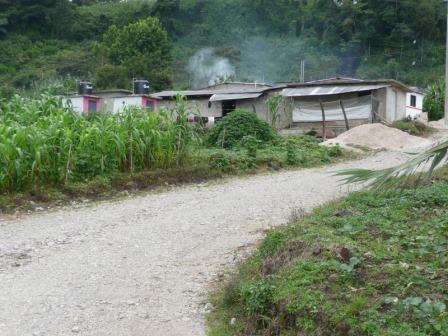
THE ROAD INTO BAYALEMO, Larrainzar Municipality, Chiapas
THE STOVE DESIGN PROCESS
BIG PILES OF WOOD
HAPPY WOMEN COOKING
WOMAN WITH LA MAZATECA
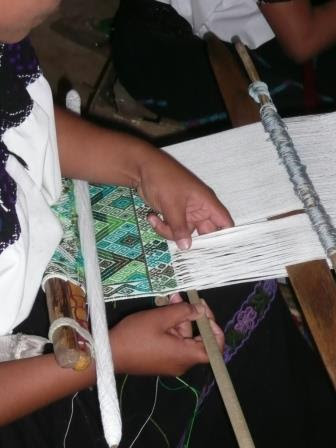
HANDS WEAVING
RICK IN A SUIT
With the help of our partner, The Hunger Project (THP), and patent attorneys associated with Invent for Humanity, we plan to secure intellectual property rights in Latin America and India. In collaboration with THP, we will help form a co-op business structure for a social enterprise starting with our current promoters (stove builders) to make the stoves available in the greater Mazateca region.
Tuesday, June 24, 2014
Stan is "On the Ground" in Chiapas Mexico
Stan left on Sunday morning to launch our stove program in Chiapas Mexico. Stan spend part of the day Monday in Mexico City (D.F.) meeting with the staff at the Hunger Project-Mexico (THP) offices then took a quick flight down to Chiapas (vs a 14 hour bus ride) on to San Christobal. He was met at the airport by Wendy (THP staff) and rode the 1.5 hours to San Christobal together. Roberto (THP staff for the Oaxaca region) will join Stan and Wendy on Wednesday along with the 4 stove "Promoters" (builders) from the Mazateca. This team will oversee the building of 2 demonstration stoves.
Late last month a group of representatives from Chiapas went to the Mazateca to see-use and meet both the stove users and builders. This was culturally significant event as these two indigenous cultural groups had never met each other. In addition they don't peak the same language! At one level this project is ground breaking as it is being lead by two indigenous cultural groups, that will work together to help expand our stove program in another region in Mexico.
In building the stoves for the families in Chiapas they wanted some modifications to the design. First, the women make tortillas sitting down, vs standing up in the Mazateca. Thus the stove will be modified to meet the specific cultural needs of these women by lowering the Comal side of the stove. Second, they wanted the other side of the cook top to be a little lower which we will accommodate. In addition they would like the next generation builds to be in a long line or "L" shape. All of which we can accommodate in the future.
The goal of this pilot build is to; first have the 'Promoters" in Chiapas learn how to build the Gen1 stove from the experienced Promoters from the Mazateca, test the modified design, and then let the families use the stoves for a few months to determine if the "like" then as much as they thing they will. They already got to use them in there prior trip to the Mazateca, and to suggest modifications and improvements so the stoves will better meet their expectations.
Stay tuned as I hope to hear from Stan (I don't know if he will have internet access or not) over the next 10 days about the progress.
Rick McKenney
Executive Director
Water for Humans
Wednesday, February 19, 2014
"La Mazateca" Video of our stove builders and users
Please check this out. It is in Spanish, we are working on translating it and we will post an English version soon.
Monday, January 20, 2014
Day one at the World Intellectual property Forum.
Rick is in Geneva at the Global intellectual property forum. I was an invited speaker last year, to talk about our work in Mexico with the Mazateca indigenous cultural group. I was invited back this year to give input from the perspective of a small NGO working at the BOP, in economically remote regions of the world.
Later tonight I will make a major announcement for Water for Humans, associated with this conference.
This is an interesting place for me to be in as most of our work and innovation is "open source", however, with our Generation 2 clean cookstove program there is the potential for I.P. and licensing of the design and implementation model.
Monday, July 29, 2013
The Cook Stove Workshop Ended Yesterday
Well, we are back in Mexico City, after four days in the Mazateca to finish the cook stove workshop. We arrived in San Jose Tenango the evening of July 24 and started the continuation of the workshop on the 25th. During the two and a half week break in the workshop, detailed lesson plans were made so that we had specific goals for each remaining day of the workshop. Each day was to end with a concrete, mortar or insulation (perlite) pour so that it could harden overnight.
For the most part, we achieved our goals each day. The exception was the final two days. On Saturday, the 27th, we wanted to complete the chimney, but we did not. The final smooth mortar for the stove top was, however, completed and there was plenty of time to install the chimney on the final day. On the last day, we ran out of sand and, therefore, could not do the final mortaring of the interior gas path (takes about one hour). The good news, though, is that Leo Dan who did this on one of the pilot stoves, lives close by and knows exactly what to do.
All in all, the workshop went well. Eighteen promoters (attendees) participated, asked a lot of questions, learned a lot, tried a lot of processes/procedures and are ready to make more stoves to really learn the process well. We are returning to Seattle tomorrow night (Tuesday, 7/30) and plan to come back in September to work with the promoters as they build eighty-eight more stoves. Meanwhile, THP and the communities have an enormous task ahead of them: to finish purchasing all the parts, transporting them to the area, distributing them properly so that each community gets the number needed for its planned stoves and manually moving the parts from the closest road to each community (up to a three hour hike).
Subscribe to:
Posts (Atom)